
Table of Contents
Understanding the low home appraisal reasons is crucial for homeowners considering refinancing their mortgages. If you’ve jumped on the refinance bandwagon, you might be surprised to learn that your home’s appraisal could come in lower than expected. With interest rates at record lows, many homeowners are eager to take advantage of refinancing opportunities. However, when the appraisal results arrive, it can be disheartening if they fall short of your expectations. In this post, we’ll explore three key factors that could lead to a lower appraisal, helping you navigate the process with confidence.
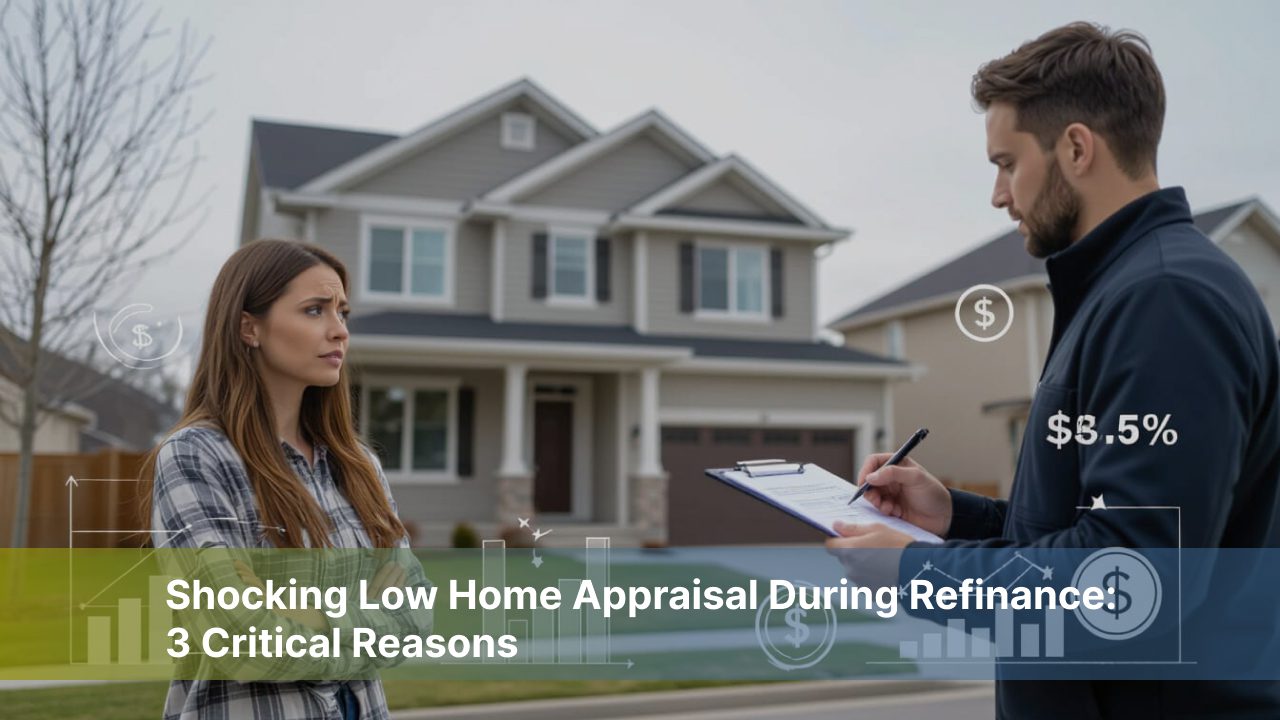
Have you jumped on the refinance bandwagon? If not, you may want to consider it. As of the end of October 2020, interest rates on a 30-year refinance mortgage were averaging around 3.2%. These are the lowest rates in the last 40 years! If you decide to take advantage of these all-time low rates, your lender will most likely order an appraisal. What happens if the new appraisal is less than the original one? Before you assume the appraiser made a mistake, let’s look at three reasons why a new appraisal could come in low.
The Case File
Three years ago, James Brown purchased a nice three-bedroom home in a quiet town with good schools. The home had been recently renovated and was in great condition. He paid $475,000. The appraisal at that time matched the purchase price.
James wants to do a cash-out refinance and get $15,000 to pay off some other debts. To make that happen, the lender says the appraisal needs to be at least $494,000. James expects it to come in close to $505,000. When the appraisal came back, however, it was for only $489,000.
James is devastated. The lender suggests that he takes out only $10,000 instead of the $15,000. The appraiser looks like the bad guy. But what could be the cause of the lower-than-anticipated value?
Reasons for Low Home Appraisal
Reason #1: The Range of Value
The primary reason appraisals differ is because, in reality, real estate appraisals are designed to provide a range of value rather than one set price. A real estate appraisal measures the actions of typical buyers and sellers in the marketplace and rarely do two buyers offer the same exact amount.
Let’s say that Mr. Brown decides to list his home. He lists it for $530,000 and expects to get an offer at $505,000. Within one week, he receives 100 purchase offers. Of those 100 offers, we could expect that approximately 30% would be ridiculously low and 10% would be high with a slew of ridiculous contingencies. The remaining 60% would be considered reasonable offers. There would be some low cash offers and some high offers with contingencies such as seller-paid closing costs or closing delays (i.e. buyer needing to sell their house first); but generally speaking, all the offers should be within 10% of each other. All the reasonable purchase offers created a range of value.
Using our example of Mr. Brown’s house, 60% of the offers would be between $480,000 and $530,000. While every seller would love to get the highest price, nearly all of the high-priced offers will have some sort of contingency that would make the offer less appealing. It is very possible that Mr. Brown may accept an offer of say, $490,000 if the buyer is paying cash and can close within two weeks. That accepted purchase price becomes the “market value” of the property.
An appraisal measures that value range within the report. Hence, Mr. Brown’s most recent appraisal of $489,000 is within that appraisal range of $480,000 to $530,000. It is possible that the appraiser may be willing to adjust the value up to the desired $494,000, since it is also within the range.
Now, here is a word of caution: federal lending requirements and appraisal standards do not allow lenders (or property owners) to “pressure” the appraiser into “hitting” a target number. The lender hired the appraiser as an independent third party to provide a non-biased estimate of value. The appraiser will decide if the market data can support a change of value, but they cannot be pressured to do so.
Reason #2: Lack of Market Data
Another reason for a difference in appraised value can be caused by a lack of supportable evidence. All appraisers rely heavily on recent sales of properties that are similar to the property being appraised. Most lenders will require that all of the sales used in the appraisal have to be sold within 6 months and be within a limited distance. This can severely limit the data available to the appraiser.
Let’s say that Mr. Brown decided to refinance in the spring after what was a record-breaking terrible winter. When you combine below-zero temperatures, tons of snow, and COVID-19 it isn’t much of a surprise that there were hardly any sales all winter. The appraiser has to use what few sales are available if he wants the bank to accept the appraisal. This lack of data can, unfortunately, slightly skew the true market value. The appraiser has to balance the requirements and stipulations set by the mortgage market with his ethical requirements to determine a fair market value for the property. In these cases, it is common for the new appraised value to differ slightly from a prior value.
Reason #3: Economic Impact
A third, and less common, reason an appraisal comes in low is due to a change in the economic climate within the market area of the subject property. We have all seen how the national economy affects property values. A change in the local economy can also raise or lower local property values.
For example, let’s say a major employer in the area of Mr. Brown’s home shut down. There was a loss of over 2,500 jobs. Because of the uncertainty of future employment, fewer people are looking to buy homes in the area. To encourage buyers, sellers slowly reduce the list price of their homes. This creates lower sale prices than were seen only one year ago. An appraisal must reflect this loss in value – even if it is only temporary.
A homeowner always hopes that his property is appreciating in value. A lower appraised value can seem devastating, but before you freak out and assume the worst, consider the possible causes. Look at the range of values contained in the appraisal report. What was the value of the cost approach (usually establishing the high range) and what were the adjusted values of each of the comparable properties (creating the low and mid ranges)? If your first appraisal is inside that number, then as long as the appraisal can be used by your lender for the refinance, do not fret, the value is still there.
You can also click here to watch a video. For more related topics, please click here.


Add your first comment to this post